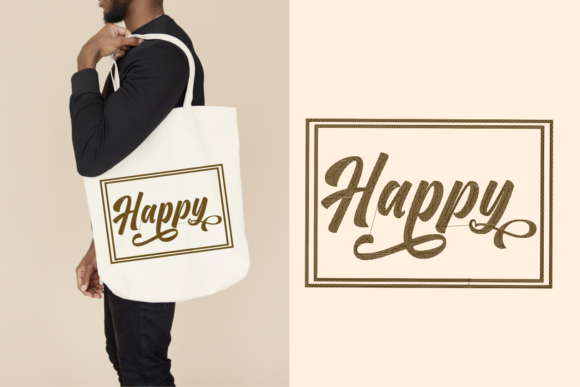
Happy Lettering: A Designer's Review for Craft Fair Success
First Impressions: A Mood That Sells
When a design arrives for review, the first question is always: what feeling does it convey to a customer glancing at a crowded craft fair table? Happy Lettering immediately lands in a sweet spot between soft, decorative, and modern. The title sets a clear expectation – it’s uplifting. This isn't a rustic farmhouse piece or a stark minimal statement; it’s a warm, approachable design with a premium decorative touch. For sellers targeting family quotes and giftable items, this mood is a direct match. The emotional hook is immediate and positive, which is a powerful starting point for any handmade product.
The Craft Fair Booth: Where Happy Lettering Shines
Imagine your booth setup: tote bags hanging on a rack, aprons displayed on a dummy, a stack of neatly folded tea towels, and a basket of embroidered patches and pouches. Where does Happy Lettering belong? My professional judgment is that it excels as a focal point on medium to large items. A tote bag or a market bag is a perfect canvas. The design likely has enough presence to be understood at a distance, drawing customers in. On an apron, positioned centrally, it becomes a cheerful kitchen statement. As a pillow cover, it transforms home decor into a gift-ready item. For caps, careful consideration is needed due to curved surfaces, but if the lettering is bold enough, it could work brilliantly as a unique, handcrafted accessory.
For smaller items like patches or fabric pouches, clarity is key. If the design has tiny details or very small lettering, it might lose its impact and readability when scaled down. Always, always stitch a test sample on your intended product fabric first. A beautiful machine embroidery design on screen can behave differently on textured towels or dense fabric like canvas.
Customer Attention and Product Value
Happy Lettering has the inherent advantage of speaking directly to a common desire: happiness. On a booth display, it naturally engages buyers looking for a heartfelt gift or a personal lift for their home or wardrobe. This emotional connection enhances perceived value. A tea towel with a generic floral pattern is just a towel; a tea towel embroidered with a happy, decorative sentiment becomes a “lovely gift for your loved ones,” as the description suggests. This is the handmade quality that justifies a higher price point and builds brand consistency for your small shop.
Practical Production: Turning a File into Profitable Products
The description mentions the machine embroidery design comes with multi formats, which is excellent for commercial embroidery. However, before batch production, here are the critical steps every embroidery designer and maker must take.
- Test on Scrap Fabric: Never skip this. Use the exact fabric you plan to sell (cotton canvas for totes, linen for towels, twill for caps). Check for puckering or distortion.
- Check Thread Contrast: How does Happy Lettering look on dark fabric versus light? Does it need a bright pop or a soft, tonal look? Experiment.
- Review Stitch Density: Dense stitch areas can be tough on thick fabrics and may require heavier stabilizer. They also affect production time.
- Confirm Hoop Size: The ideal hoop size determines which products are feasible. Can it fit in a standard hoop for a tote bag panel, or does it require a larger frame?
- Create a Real Mockup: Photograph this actual, stitched product. A real mockup photographs infinitely better for Etsy listings and printable mockups than a digital render. It shows the true texture and handmade quality.
- Compare Fabric Colors: Does the design look best on neutral backgrounds, pastels, or bold colors? Your booth display should show its versatility.
- Confirm Commercial Licensing: Before selling any finished product, verify that your purchase of this digital embroidery file includes a license for commercial use. This is foundational for any embroidery business.
Batch Production and Online Sales
For craft fair sellers, repeatability is crucial. Happy Lettering, if it stitches cleanly and without excessive thread changes, could be excellent for batch production of a focused product line, like a series of happy-themed tote bags. For Etsy sellers and digital sellers, this design is a strong design asset. Its clear, positive theme makes it easy to market. When photographing, ensure your images capture the stitch detail and the emotional appeal—maybe show it on a cozy pillow in a well-lit room or on a crisp apron in a kitchen setting.
Careful-Use Notes for the Professional Maker
Based on the category of family quotes and embroidery, some practical warnings apply. Lettering designs can be tricky. If the lettering in Happy Lettering is particularly intricate or slim, be cautious on textured surfaces like terry cloth towels or on curved caps where stitches can distort. Small lettering might not translate well to a small patch. Always consider the end use. An embroidered patch needs robust, clear outlines. For items like dark fabric pouches, a strong, contrasting thread color is non-optional to maintain clarity and visual appeal.
Also, consider how the design works as both a large focal point and a smaller accent. Perhaps the main “happy” element is large and bold, perfect for a tote, while secondary elements could be delicate. Understanding this hierarchy helps you place it optimally on different craft fair products.
Final Judgment for the Creative Entrepreneur
Happy Lettering presents a compelling opportunity for creative entrepreneurs. Its mood aligns perfectly with popular gift and home decor markets. Its strength will be on products where its sentiment can be fully appreciated: home decor like pillow covers, everyday carry items like tote bags, and personal wear like aprons. Its potential weakness lies in applications where scale or surface texture might obscure its message.
To maximize its success at your next handmade market, I advise selecting one or two primary products to feature it on in your booth. Make those samples impeccable. Use them to tell a story. A tote bag with Happy Lettering isn't just a bag; it's a “carry-your-happiness” bag. An embroidered tea towel isn't just a towel; it's a “kitchen cheer” towel. This framing, supported by a well-stitched, high-quality finished product, will capture buyer engagement and turn a beautiful machine embroidery design into a profitable, beloved craft fair product.